
Turkey’s Democratic Ceiling

Namık Kemal, one of the leading Young Ottoman intellectuals, wrote in 1868:
“Sick Man… they call him that in France.
Its head resting on the most beautiful spot of the cradle of civilization we call Europe; its body stretching across the most important places of three continents, Asia, Europe, and Africa; once young, vigorous and a beautiful Spartan, but now agonizing in its death bed. Its name? The Sublime State…
The cause of its sickness is the shortage in statesmen, the shortage in goods, the shortage in soldiers, the shortage in tools and equipment, the shortage in everything. The cause of all shortages is, however, the government oppression.”
There is something painful in reading these lines today.
Namık Kemal wrote these words more than 150 years ago. He looked at the political condition of his country and saw government oppression at the root of its weakness. Whether he was fully right in his diagnosis is not the point. I am not sure he was. The point is that, more than a century and a half later, Turkish intellectuals still complain about the same thing.
Since then, a lot has changed. The empire collapsed. The republic rose. The capital changed. The alphabet changed. Constitutions were written and rewritten. Parties rose and fell. Soldiers intervened and withdrew. Leaders promised liberty and produced obedience. Each generation found new words for the same old problem.
But the complaint remained.
As the French saying goes: “Plus ça change, plus c’est la même chose.”
The V-Dem graph gives this story its visual form.
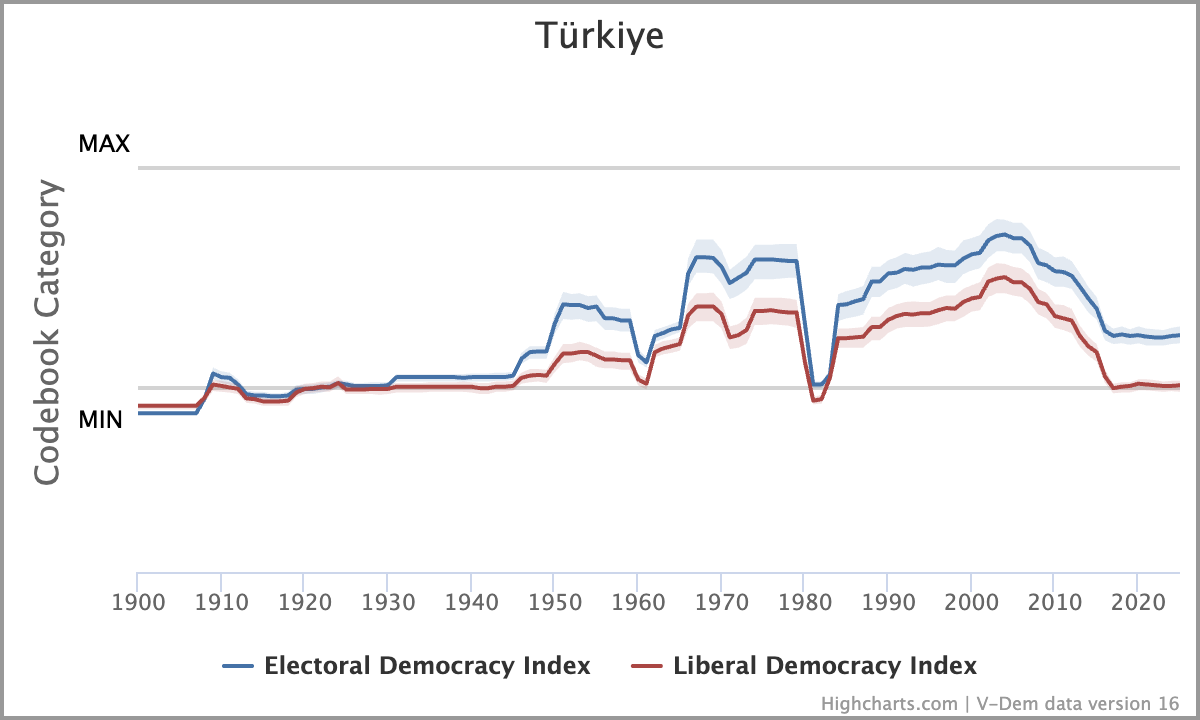
It is not that Turkey has never moved. Turkey did move. There were openings. There were moments of reform, competition, and hope. There were elections that mattered. There were years when public life became freer and politics became more open.
But the line rises, then falls. It rises again, then falls again. Turkey climbs toward democracy, but it seems unable to climb beyond a certain point. As if there is an upper limit Turkey cannot cross.
As if failure is its destiny.
The graph is painful because it is not a picture of no trials. It is a picture of failed trials. It is a picture of rising hopes and repeated frustrations.
This is why Namık Kemal does not speak only of the past. His is not merely an Ottoman complaint from a lost world. He sounds too familiar. A writer from 1868 speaks, and one does not have to translate the political emotion his words evoke. The vocabulary has changed. The wound has not.
Why does Turkey climb and fall back? Why do democratic openings remain so vulnerable? Why does the country repeatedly approach freedom without securing it? Why does every generation have to rediscover what Namık Kemal already said?
I do not know whether lack of democracy is Turkey’s destiny.
But I understand why it can feel that way.
When the same complaint survives empire, republic, coups, reforms, elections, and revolutions, it becomes hard to treat it as an accident. It begins to look like a ceiling. Not an absolute ceiling, perhaps. Not a law of nature. But something real enough to be seen on a graph and felt across generations.
Namık Kemal looked at the sick man and blamed oppression.
We look at the graph and see a country still struggling with the same illness.
That is the lament.
Is this a "natural" ceiling originated from the nature (education, religion, culture etc..) of the people living on this land or it is a ceiling decided by the imperialist world, or both? Doğan Avcıoğlu claims that our geographical position was a disadvantage for us. Isolation of the Japan was an advantage for them. When we are so integrated to western world, how easy we can change our role within this world?
I am just thinking out loud.